Complex & Intelligent Systems · 2024
CitySEIRCast: An Agent-Based City Digital Twin for Pandemic Analysis and Simulation
Abstract
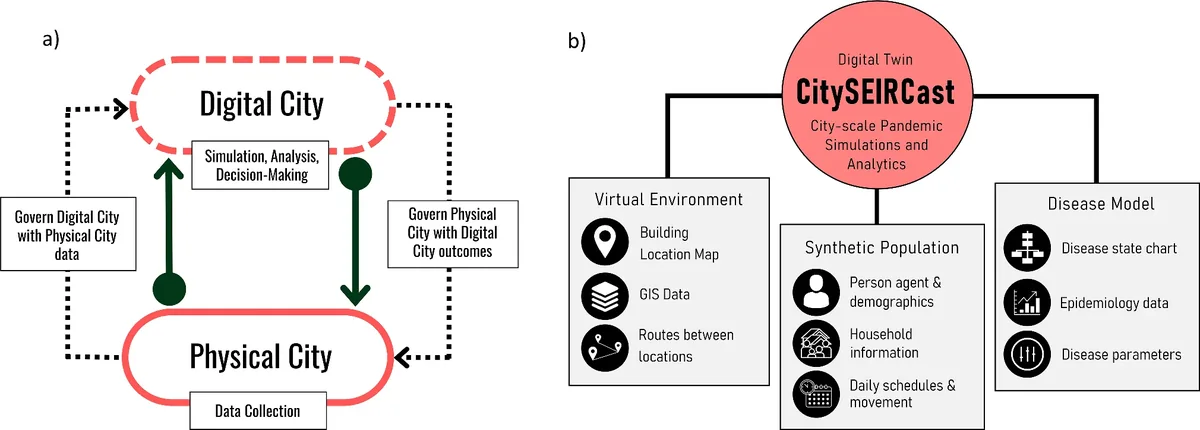
The COVID-19 pandemic has dramatically highlighted the importance of developing simulation systems for quickly characterizing and providing spatio-temporal forecasts of infection spread dynamics that take specific accounts of the population and spatial heterogeneities that govern pathogen transmission in real-world communities. Developing such computational systems must also overcome the cold-start problem related to the inevitable scarce early data and extant knowledge regarding a novel pathogen's transmissibility and virulence, while addressing changing population behavior and policy options as a pandemic evolves. Here, we describe how we have coupled advances in the construction of digital or virtual models of real-world cities with an agile, modular, agent-based model of viral transmission and data from navigation and social media interactions, to overcome these challenges in order to provide a new simulation tool, CitySEIRCast, that can model viral spread at the sub-national level. Our data pipelines and workflows are designed purposefully to be flexible and scalable so that we can implement the system on hybrid cloud/cluster systems and be agile enough to address different population settings and indeed, diseases. Our simulation results demonstrate that CitySEIRCast can provide the timely high resolution spatio-temporal epidemic predictions required for supporting situational awareness of the state of a pandemic as well as for facilitating assessments of vulnerable sub-populations and locations and evaluations of the impacts of implemented interventions, inclusive of the effects of population behavioral response to fluctuations in case incidence.
At a Glance
- Background
- City-scale epidemic forecasting must handle population/spatial heterogeneity and early-data scarcity, calling for high-resolution digital-twin simulation
- Problem
- Couple an agent-based transmission model with real-world city data pipelines to deliver timely, high-resolution forecasts
- Method
-
- Build a city digital twin from navigation and social data, coupled with a modular agent-based SEIR model
- Automate pipelines for scalable execution on hybrid cloud/HPC
- Results
-
- Realistic city-level simulations with high-resolution spatiotemporal forecasts
- Actionable for identifying vulnerable groups/hotspots and evaluating policy scenarios
- Role
-
- Analyzed and cleaned county-provided COVID data (validation, missing-data handling, metadata curation)
- Set up the HPC environment (Slurm, modules, containers) and large-scale batch pipelines
- Optimized Python/C++ simulation code; implemented the agent-based SEIR application end to end
- Deployed on Azure with containers; configured monitoring and logging